UfAB 2018 Evaluation Scheme
As an alternative to the standard rating scheme, the bill of quantities can also be used to create a valuation scheme using the simple or extended guideline value method in accordance with UfAB 2018.
Basic Principles and Calculation Formulas
With this evaluation method, the criteria groups and individual criteria receive different weighting points depending on their importance.
As part of the tender evaluation, evaluation points in the range from 0 to 10 are awarded for the individual criteria.
The points awarded according to the formula
calculated performance points are used to determine the key figure for the performance-price ratio using the following formula:
-
Z: Key figure for the performance-price ratio
-
L: Total sum of service points (across all groups in the bill of quantity)
-
P: Price (in euros)
This key figure (Z) is decisive for the most economical offer according to the Simple Reference Value Method.
In the case of the extended indicative value method, a pre-selection of tenders is made within a range of fluctuation and the most economical tender is determined from this with the help of an additionally defined decision criterion.
Further details on the evaluation according to UfAB can be found on the Internet at http://www.kbst.bund.de/.
Inserting a UfAB 2018 Evaluation Scheme into the BQ
Follow the instructions below to insert a scoring scheme according to UfAB 2018 into your bill of quantity:
-
Delete the default rating scheme of your bill of quantities via the context menu Remove or with the Remove button (black X) on the toolbar (1) of the bill of quantities.
-
Click on the bill of quantities icon in the outline. The New toolbar now contains the Standard evaluation scheme button.
-
If you point the mouse at this button without clicking, the selection list will expand downwards. Select the entry UfAB-2018 scoring scheme . An empty scoring scheme according to UfAB 2018 will be inserted into your bill of quantity.
Tip
- After deleting the standard evaluation scheme of your bill of quantities, right-click on the bill of quantities icon in the outline (3).
- Select the menu item NEW and then the entry UFAB- 2018-VALUATION SCHEME. The empty scoring scheme according to UfAB 2018 is inserted.
The following input fields are available for completion in this scoring scheme:
| Field | Description |
|---|---|
| Description | mandatory field : Name/title of the rating scheme. Free text input possible. |
| Long description | Notes, detailed explanations of the rating. Free text input possible. |
| Scaling factor for the key figures | Preset with 100,000.00. Multiplier for the key figure (Z) to display it as a whole number and improve its readability. |
| Range in % | Check this box to select the extended guideline method instead of the simple one. Further input fields are displayed. |
| Decision criterion | Mandatory field for extended guideline value method: Percentage value, pre-assigned with 6 %. Range that deviates downwards in percentage terms from the key figure of the leading offer. Bids are preselected within this "corridor". Mandatory field for extended guideline value method: Criterion for determining the most economical bid within the fluctuation range. The price is preset . |
| Justification for the evaluation method used: | Here you can enter a justification for the choice of evaluation method. |
| Distributable weighting points (GP) | mandatory field: Sum of the weighting points according to the top-down approach, i.e. the points are distributed from top to bottom: Scoring scheme → main criteria group → criteria group → criteria element. |
Create UfAB Main Criteria Groups
Info
You cannot insert individual criteria at the top level of the UfAB 2018 evaluation scheme. This level is reserved for the main criteria groups.
Add one or more new main criteria groups as described in the chapter Create criteria group.
The following input fields for groups are available for you to fill in:
| Field | Description |
|---|---|
| Name | Mandatory field:** Name/title of the criteria group. |
| Sum of weighting points (GP) | Pure display field: Shows the sum of the weighting points of all B criteria in the group. |
| Minimum points (MP) | Optionally enter a minimum number of performance points for this group. If the score falls below this value, the corresponding bid cannot be awarded the contract. |
Enter any number of criteria groups within the main groups.
Info
You cannot create any further criteria groups within the criteria groups, i.e. the criteria groups are all distributed at the same level within the main criteria groups.
Create UfAB Criteria
Enter any number of criteria elements within the groups. Please also refer to the chapter Create criteria.
When inserting individual criteria, you can choose between A and B criteria.
A criteria are exclusion criteria, i.e. the requirement is either fulfilled (yes) or not fulfilled (no). These criteria are not weighted. As part of the tender evaluation, the fulfillment of all A-criteria is checked in a preliminary review. Tenders that do not meet an A criterion cannot be awarded a contract.
B criteria are evaluation criteria, i.e. they are given weighting points depending on their importance. The sum of the weighting points of all criteria in a group is displayed at group level, see display field Sum of weighting points (GP) in the table above.
The following input fields are available for B criteria:
| Field | Description |
|---|---|
| No. | Number of the criterion in the evaluation scheme. Is assigned automatically. |
| Description | ** Mandatory field:** Short description/title of the criterion. |
| Criteria text | Indicate how many evaluation points (BP) are awarded for which criteria fulfillment. |
| File attachment for explanations by the awarding authority | Click on the paperclip symbol  to add a file attachment that contains further information on the criterion and becomes part of the award documents. to add a file attachment that contains further information on the criterion and becomes part of the award documents. |
| Publish element? | The radio button is preset with Yes: Indicates whether the criterion is to be published. |
| Publish weighting? | radio button with Yes prefilled: Specifies whether the weighting of the criterion is published if the criterion is also published. |
| Weighting points (GP) | Mandatory field:** Number reflecting the value and importance of the criterion. |
| Reason for weighting | For reasons of traceability, enter an internal reason for the award procedure of the weighting points here. |
Error Messages
When validating the bill of quantity, the sum of all weighting points at the top level of the UfAB 2018 scoring scheme is compared with the entry in the Allocatable weighting points field.
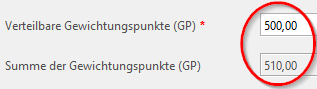
An error message is displayed in the event of deviations.

At criteria group level, the system checks whether the specified minimum number of points (MP) exceeds the maximum achievable credit points (CP) for this group.
In the example below, a warning message is displayed because
LP = weighting points (GP) * maximum assessment points (BP) \< MP
Example in numbers:
LP = 100 GP * 10 BP =1000 LP \< 1001 MP\s

Numbering in the UfAB Scoring Scheme
The numbering of the elements in the UfAB scoring scheme is standardized to facilitate orientation.
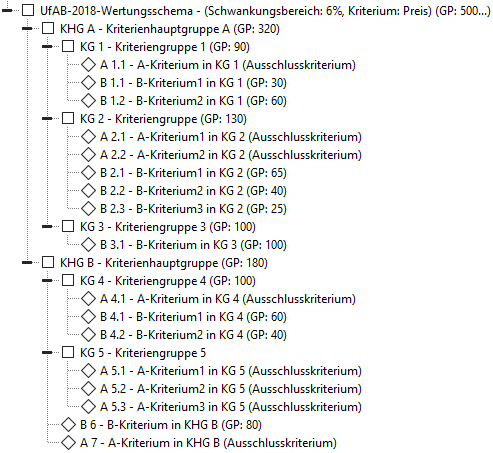
Main groups always have the abbreviation KHG and a letter in alphabetical order, e.g. KHG A, KHG B etc.
Criteria groups have the abbreviation KG and are numbered from top to bottom within the evaluation scheme. If criteria groups are subsequently added or deleted, the numbering is automatically adjusted.
Criteria are abbreviated with the letter A = exclusion criterion or B = evaluation criterion. Individual criteria can also be created within the main groups and then receive a consecutive number after the letter. You can change the order of the individual elements within the main group by dragging them with the mouse (drag & drop method). This changes the number after the letter, e.g. B 6 and A 7 in the example above becomes A 6 and B 7 after moving.
Info
Individual criteria in main groups are always listed under the criteria groups.
The criteria within the criteria groups differ from the individual criteria from the main groups by the double numbering, e.g. A 1.1 or B 1.1. The first digit represents the group membership and the second stands for the order within the criteria type, i.e. the numbering of the criteria elements of type A and B is separate within the group. Therefore, there can be both criterion A 1.1 and criterion B 1.1 in a group.
Evaluation Methods in the UfAB 2018 Evaluation Scheme
Simple Guideline Value Method
Bills of quantity with precise, standardized specifications, with numerous A criteria and few B criteria are suitable for this evaluation, as in this case the inaccuracies to be assumed are small and the fluctuation range can be neglected.
To determine the most economical tender, only the ratio between the performance points and the price is calculated here using the following formula
Extended Standard Value Method
In complex procurement processes with predominantly functional specifications and numerous B-criteria, the presumed inaccuracy in the evaluation can reach a relevant size, resulting in a fluctuation range that must be taken into account due to its size.
To determine the most economical tender, a further decision criterion is used here in addition to the performance/price ratio (Z) for tenders that are close to each other.
This method comprises several steps:
-
Determining the key figure Z for the performance-price ratio using the same formula as already described for the Simple Indicative Value Method.
-
Pre-selection of bids within the defined varying range.
-
Compare this selection of offers on the basis of a previously defined decision criterion.
Tip
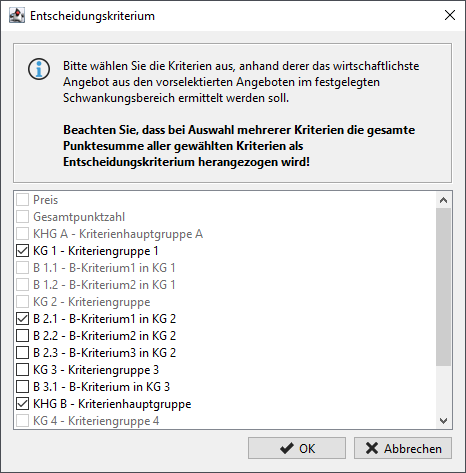
Click on the LUPEN icon to the right of the DECISION CRITERION field in the UfAB 2018 evaluation scheme form. The selection list of criteria is displayed. If a selection is made, the criteria that cannot be combined with this selection appear grayed out. You cannot combine individual criteria with the groups in which they are contained. The sum of the credit points of all selected criteria is used for the calculations in the extended guideline value method.
Info
The price and the total score cannot be selected together with other criteria.
Info
The decision in favor of the Simple or Extended Indicative Value Method as well as the determination of the fluctuation range and the additional decision criterion are included in the printout of the bill of quantity, therefore the prescribed transparency in the tender documents is guaranteed to the bidders
Example of figures for the extended indicative value method
| Criterion | Offer 1 | Offer 2 | Offer 3 | Offer 4 | Offer 5 |
|---|---|---|---|---|---|
| Performance points (L) | 9,500 | 9,200 | 8,900 | 8,500 | 7,400 |
| Price in € (P) | 120,000 | 105,000 | 100,000 | 98,000 | 110,000 |
| Code Z = L/P | 0.079 | 0.088 | 0.089 | 0.087 | 0.067 |
| Scaling | Multiplier \(Z_{new}\) = \(Z_{old}\) * 100 | ||||
| Code \(Z_{new}\) | 79 | 88 | 89 | 87 | 67 |
| Variation range = 6 % → Corridor: 89 to 84 | Outside SB | Inside SB | Inside SB | Inside SB | Outside SB |
| Ranking of the bids for the decision criterion Price → Award for Bid 4 | 3 | 2 | 1 | ||
| Ranking of the bids for the decision criterion Performance points → Award for Bid 2 | 1 | 2 | 3 |
The Simple Indicative Value Method would have determined Bid 3 as the most economical bid based on the Code (Z).
Weighted Indicative Value Method with Median (not part of UfAB 2018)
The weighted indicative value methods are recommended if the performance and price are to be weighted differently when determining the most economical tender. The two methods differ in the way in which the reference points (reference values) required in the formulas are determined for the performance points or for the price.
With the median method, the reference value is calculated by determining the median value (median) of all performance points used for the evaluation and the median of all prices used for the evaluation.
Info
The median of a number series function (not to be confused with the mean value!) is the number below and above which half of the series members are located. Spreadsheet programs usually contain a formula for calculating the median.
Example for 5 numbers:
MEDIAN(number1=29; number2=13; number3=81; number4=53; number5=77) = 53
The medians are determined after the receipt of bids. To determine the median of all performance points and the median of all prices, only those tenders that remain after completion of evaluation stages 1 to 3 may be taken into account.
The median method can be represented by the following formula
Abbreviations
| Abbreviation | Meaning |
|---|---|
| Z(Offer): | Key figure for performance-price evaluation of the offer to be evaluated |
| WF(Service): | Value factor for the service from the tender documents |
| L(Tender): | Performance score of the tender to be evaluated |
| L(Median): | Median of all performance points |
| WF(Price): | Value factor for the price from the tender documents |
| P(Median): | Median of all prices |
| P(Offer): | Price of the offer to be evaluated |
Info
The decision in favor of the Weighted Indicative Value Method with median as well as the determination of the value factors for the service and for the price are included in the printout of the specifications, therefore the prescribed transparency in the tender documents is guaranteed to the bidders.
Example of figures for the median method
| Criterion | Offer 1 | Offer 2 | Offer 3 | Offer 4 | Offer 5 |
|---|---|---|---|---|---|
| Performance points (L) | 9,500 | 9,200 | 8,900 | 8,500 | 7,400 |
| Price in € (P) | 120,000 | 105,000 | 100,000 | 98,000 | 110,000 |
| Value factor performance | 60 % | ||||
| value factor price delivery | 40 % | ||||
| Key figure Z = L/P | 0.1833 | 0.2202 | 0.2190 | 0.1997 | 0.0798 |
| Scaling | Multiplier \(Z_{new}\) = \(Z_{old}\) * 100 | ||||
| Code \(Z_{new}\) | 18.33 | 22.02 | 21.90 | 19.97 | 7.98 |
| Ranking of bids → Award for Bid 2 | 4 | 1 | 2 | 3 | 5 |
Weighted Reference Value Method with Reference Value (not part of UfAB 2018)
With the reference value method, the reference value for the price and the performance points is determined by the awarding authority on the basis of the information on the market situation that was collected during the preparation of the award procedure.
As the previously determined reference values can have a direct influence on the ranking when determining the most economically advantageous tender, this method should only be used if there is a sufficient degree of certainty regarding the accuracy or market appropriateness of the determined reference values.
The reference value for the service must not be set unreasonably high, but also not too low, and must be based on the procurement object. As a rule of thumb, the reference value could generally be set at around 75% of the maximum achievable performance points (e.g. 7,500 points with a maximum score of 10,000 points).
Info
The decision in favor of the weighted reference value method with median as well as the determination of the value factors for the service and for the price are included in the printout of the bill of quantities, therefore the prescribed transparency in the tender documents is guaranteed for the bidders.
The reference value method can be represented by the following formula
Abbreviations
| Abbreviation | Meaning |
|---|---|
| Z(Offer): | Key figure for performance-price evaluation of the offer to be evaluated |
| WF(Service): | Value factor for the service from the tender documents |
| L(Tender): | Performance score of the tender to be evaluated |
| L(Median): | Median of all performance points |
| WF(Price): | Value factor for the price from the tender documents |
| P(Median): | Median of all prices |
| P(Offer): | Price of the offer to be evaluated |
Numerical example for the reference value method
| Criterion | Offer 1 | Offer 2 | Offer 3 | Offer 4 | Offer 5 |
|---|---|---|---|---|---|
| Performance points (L) | 9,500 | 9,200 | 8,900 | 8,500 | 7,400 |
| Price in € (P) | 120,000 | 105,000 | 100,000 | 98,000 | 110,000 |
| Maximum achievable credit points | 10,000 | ||||
| Reference value performance | 7,500 | ||||
| Reference value price | 105,000 | ||||
| Value factor performance | 60 % | ||||
| Value factor price | 40 % | ||||
| Code \(Z_{new}\) | 0.3028 | 0.3360 | 0.3310 | 0.3066 | 0.1729 |
| Scaling | Multiplier \(Z_{new}\) = \(Z_{old}\) * 100 | ||||
| Code \(Z_{new}\) | 30.28 | 33.60 | 33.10 | 30.66 | 17.29 |
| Ranking of bids → Award for Bid 2 | 4 | 1 | 2 | 3 | 5 |